

Council chief executives gathered in Te Whanganui-a-Tara Wellington on 5 March for the Navigating Reform Chief Executive Forum, hosted by Taituarā at PwC House.
The forum brought together local government leaders to share insights, discuss the scale of reform facing the sector, and strengthen connections across councils.
With a significant programme of change underway, including resource management reform, water reform, structural change, development levies and broader system changes, the day focused on helping chief executives build a clearer picture of what lies ahead and how councils can respond.
Economic outlook and reform pressures
Economist Brad Olsen from Infometrics opened the forum with an overview of the economic outlook heading into 2026. His presentation highlighted the pressures councils continue to face, including inflation tracking in the wrong direction, ongoing cost pressures, construction sector forecasts and policy changes such as rates capping.
Following his presentation Olsen noted the need for good data in decision making:
“There are lot of challenges out there in the local government sector with a lot of reform coming through from central government and the diversity of the sector increases the complexity of this. The scale of services varies widely across communities, but having better information and good data means that when you’re making a decision, at least it’s better informed. You can identify some of the challenges but also the opportunities.”


Legal and policy implications
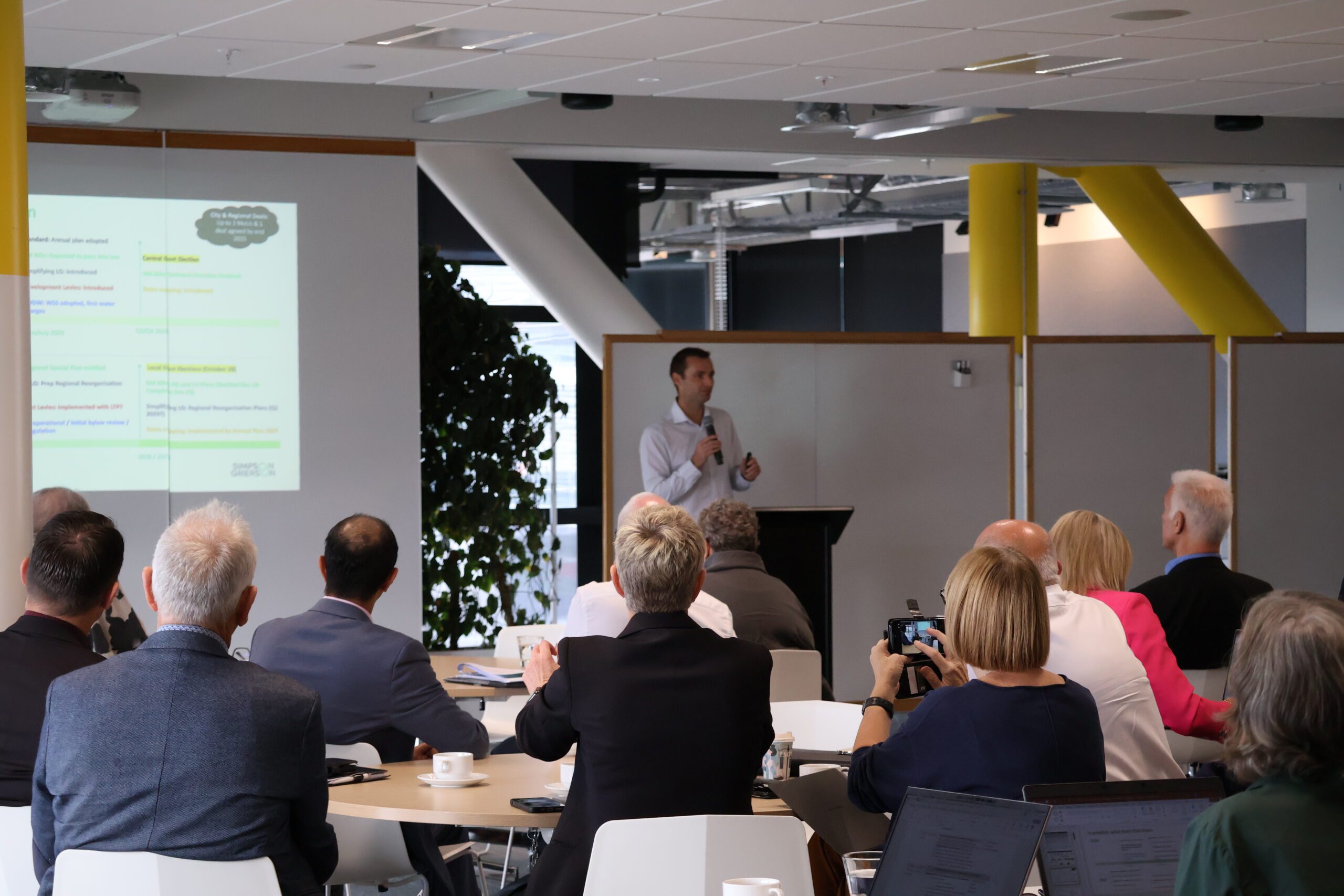
Mike Wakefield and Jonathan Salter from Simpson Grierson explored the legal and policy implications of the Government’s reform programme, covering key timelines, risks and pressure points across the range of reforms.
Their presentation highlighted the complexity of the current reform landscape and the importance of clarity and stability in policy settings as councils work through major structural and regulatory change.
Ministry for the Environment
Nadeine Dommisse, Deputy Secretary, Planning System Transformation at MFE alongside colleagues Natasha Lewis, Deputy Secretary Strategy, Stewardship and Performance, and Sara Clarke, General Manager System Enablement and Oversight, provided an update on the Ministry’s work to reform the resource management system and the wider planning framework.
They acknowledged the sheer volume of reform facing the local government sector, noting that multiple programmes of change are progressing simultaneously across central government.
The presentation emphasised that the current phase of the Resource Management Act reform is focused on building strong foundations for the new system. While the need for reform is widely recognised, “the devil is in the detail” and it is critical that the new system improves on what came before.
The presentation highlighted several key areas of focus, including:
- Ensuring reforms work in practice for end users and ultimately deliver a simpler system that improves outcomes
- Clarifying the role of iwi and Māori, including how Treaty settlement outcomes will be reflected in the new framework
- Taking a “digital first” approach while building on systems councils already have in place
CEs raised concerns around the speed of implementation required alongside the cost of transition, suggesting the sector was being made to do ‘more mahi, for less money”.
The Ministry signalled its intention to undertake a nationwide readiness snapshot, including plans to engage directly with councils across the country, to better understand how prepared the sector is for the scale of change ahead.
Service delivery and structural change
The afternoon session, led by facilitator, Anne Pattillo, focused on service delivery and potential structural change across the sector. Discussions explored different models including shared services, federated approaches and “coalitions of the willing” between councils.
Participants reflected that while structural amalgamation can be difficult politically, there are practical opportunities for councils to collaborate more closely in areas where shared delivery could improve efficiency and value for money. Further work would need to be done to identify what’s not working and if remodelled service configurations could be an effective solution.



Stronger together
Throughout the day, a consistent theme was the importance of connection and knowledge sharing across the sector during this period of change and uncertainty. There is a value in working together to share challenges and potential solutions along with having a strong local government voice in the conversations with central government.
The establishment of a new Ministry of Cities, Environment, Regions and Transport (MCERT) was identified as a key opportunity for local government to connect at a leadership level with just one powerful agency. The importance of this for developing the Regional Spatial Plans was also noted.
While not every chief executive was able to attend in person, all council CEs have received the presentations shared on the day, ensuring the insights and discussions can benefit the whole sector.
As the pace of reform continues, the forum reinforced the value of coming together to share perspectives, learn from each other and work collectively to navigate what lies ahead.